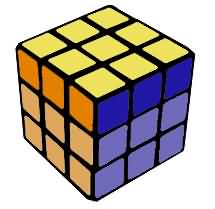
U permutations
These 2 PLLs are both 3 edges cycle, in either clockwise or anticlockwise directions. Put the solved side behind and execute the respective algorithm. These 2 algorithms are Erik Akkersdijk's M slice style. It's much faster once the M slice trick is mastered. The sequence of M turns is the same for both cases. The only difference is the direction of the U turns. To execute the U perm with the solved side facing you, simply inserve the M slice turn. |
| 01 |
Ub |
 |
M2' U' M U2' M' U' M2' |
clockwise. all U' turns. |
| 02 |
Ua |
 |
M2' U M U2 M' U M2'
|
anticlockwise. all U turns. |
A permutations
The two algorithms below cycle 3 corners in either clockwise or anticlockwise direction. In both cases, there is a corner side that has been aligned properly. Put the solved corner on your left front side. Instead of recognizing the direction of the unsolved pieces, look at the pair of corner stickers instead. If it is at the back, it is case PLL04. If the sticker pair is on your right, immediately you should recognize it as PLL03. The finger tricks for both cases is similar, as they are inverse of one another. Practise D turns with left ring finger or with full right palm swing. |
| 03 |
Ab |
 |
x (R2’ D2) (R U R’) D2 (R U’ R) |
Anticlockwise. Pair on right. |
| 04 |
Aa |
 |
x (R’ U R’) D2 (R U’ R’) D2 R2 |
Clockwise. Pair at the back. |
4 edges cycle
The two PLLs below, H and Z, has all the corners correctly positioned and all the edges incorrectly placed. After adjusting top layer to place the corners in their correct position, differentiate these two algorithms by determining whether it is an opposite swap or diagonal swap of edges. Similar finger tricks for both.. It takes some time to make it smooth, but it is incredibly fast after you get it right. |
| 05 |
H |
 |
M2’ U' M2’ U2' M2’ U' M2’ |
Opposite swap of edges |
| 06 |
Z |
 |
M2' U' M' U2 M2' U2 M' U M2 |
Diagonal swap of edges |
T and J permutations
The PLL07 and PLL08 permutations are basically the same. Bring the last four moves in T permutation to the front and you will get PLL08. PLL09 is the mirror of PLL 08, you can perform the PLL08 using left hand, but it's very slow for me so I use a different approach involving swapping of left and right hand. |
| 07 |
T |
 |
(R U R’ U’) R’ F R2 U’ (R’ U’ R U R’ F’) |
|
| 08 |
Jb |
 |
(R U R’ F’) (R U R’ U’) R’ F R2 U’R’ U’ |
Similar to PLL07. |
| 09 |
Ja |
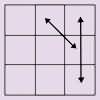 |
R' U2 R U z D' (R2' U R' D R U') |
Got this from Erik Akkersdijk. The finger trick is crazily cool. |
The odd PLLs
These two algorithms are the odds one and I can't really find a group for them, hence, they are both stuck in this group. Despite their oddness, the algorithms are pretty cool and easy. Y permutation is made up of two OLL alrogirthms: OLL13 followed by OLL12. It is a very nice but long algorithm with familiar triggers. For PLL11, 4 sets of RUR turn connected by D turn. It is not that hard to recognize this case as none of the sides has a correctly solved corner. |
| 10 |
Y |
 |
F R U’ (R’ U’ R U) R’ F’ (R U R’ U’) (R’ F R F’) |
|
| 11 |
E |
 |
x' (R U’ R’) D (R U R’) D’ (R U R') D (R U’ R') D' |
|
R permutations
Presenting the two very fun to execute mirror algorithms. In PLL12, the first U2 is done by right hand double flick trick, and the second U2' is done by double flicking right thumb with left index finger. Many cubers do it differently but I find this the best way to execute it. For PLL13, you could just mirror the right hand actions of PLL12 using left hand, or you can follow this very smooth algorithm from Erik Akkersdijk as well. |
| 12 |
Rb |
 |
(R’ U2 R U2') (R’ F) (R U R’ U’) (R’ F’) R2 U’ |
|
| 13 |
Ra |
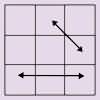 |
U’ R U' R' U' R U R D R' U' R D' (R' U2 R') |
|
V and F permutations
Many cubers execute these two PLL very differently, with many cube rotations. I'm never good with cube rotations and hence the algorithms below from badmephisto with only one intergrated cube rotation. It flows especially smooth as well. Notice that there is an additional U turn in PLL15 at the beginning and then another U' at the end to cancel the U move. Other than that, both the algorithms are identical. |
| 14 |
V |
 |
(R’ U R’ d’) (R’ F’) (R2 U’ R’ U) (R’ F R F) |
|
| 15 |
F |
 |
(R’ U2 R’ d’) (R’ F’) (R2 U’ R’ U) (R’ F R U’ F) |
|
N permutations
Mirror of one another, the two N permutations always give headache to cubers when executing them. Below are the possibly best algorithms that I can find online in attempt to execute them in the most smooth flowing manner. |
| 16 |
Nb |
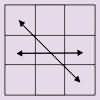 |
(R' U R U') R' F' U' F R U R' F (R' F' R U' R) |
|
| 17 |
Na |
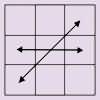 |
(R U' R' U) l U F U' R' F' (R U' R U) (l' U R') |
|
G permutations
There are four cases of G permutation (PLL18 to 21). They all contains a pair of “eyes”, ie. same color stickers positioned at the corners on the same side . To differentiate them, rather than tracking the complicated arrows, look at the empty space in the diagram. It is the only solved 2x1x1 side. Place the eyes on your left hand side, then determine whether the solved 2x1x1 block is either at the back (PLL18), close right (PLL19), front (PLL20), or far right (PLL21). You need some really cool fingertricks in order to perform these seemingly slow but actually fast algorithm. |
| 18 |
Gd |
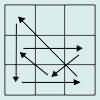 |
R2’ u’ (R U’ R) (U R’ u R2) (f R’ f’) |
Inverse of PLL19 |
| 19 |
Gc |
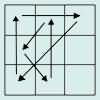 |
(R U R’) y’ (R2’ u’ R U’) (R’ U R’ u) R2 |
Inverse of PLL18 |
| 20 |
Ga |
 |
(R2 u) (R’ U R’ U’ R u’) R2’ (b’ R b) |
Inverse of PLL21 |
| 21 |
Gb |
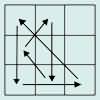 |
(R’ d’ F) (R2 u R’ U) (R U’ R u’) R2’ |
Inverse of PLL20 |