 |
Beginner's Solution
Basic Cube Concepts
There are few concepts that you need to grasp before solving the cube.
01
A rubik's cube contains 6 different faces since it is 3 dimensional.
 |
 |
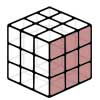
| Right Face: R |
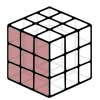
Left Face: L |
 |
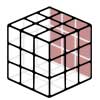 |
| Front Face: F |
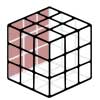
Back Face: B |
 |
 |
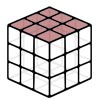
| Up Face: U |
Down Face: D |
|
02
You might be confused when looking at the cube. It is so colorful and you have no idea which pieces should move where. When experienced cubers look at the cube, however, they will don’t look at the colors. They recognize the PIECES instead. The Rubik's Cube consist of 26 pieces: 6 center pieces, 8 corner pieces, and 12 edge pieces. Each of them are unique and specific; there is no two similar pieces on one cube. Notice that the corner pieces are consist of 3 colors and they cannot be put in the place of the edge pieces that consist of only 2 colors.
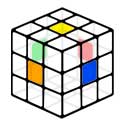 |
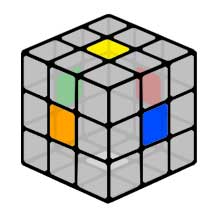
6 Center pieces: one color each. For example: the yellow center. |
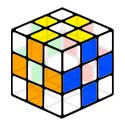 |
12 Edge pieces: 2 colors each. For example, the orange-blue edge. |
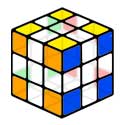 |
8 Corner pieces: 3 colors each. For example, the yellow-blue-orange pieces. |
|
03
Center pieces are unmovable on a Rubik's Cube. No matter how you turn the cube surfaces, the center remains in the same position. Therefore, on a standard sticker color scheme rubik's cube, you will notice that white is always opposite of yellow, blue is always opposite of green, and red is always opposite of orange.
04
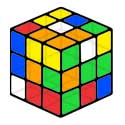
Since the center is nonmovable, the color of the center piece will determine the color of the face.
For example, a surface with white center, when the cube is return to solved state, the surface will be filled with white color.
 |
After solving the white
color-->
|
 |
|
05
You have to first understand the "cube language" before you can decipher the algorithms used throughout this website.
An algorithm means "a memorized sequence of moves whose effect on the cube is known". In order to convert a sequence of moves performed on rubik's cube into words, we use cube notations. That's how cubers communicate among each other. I have prepared another page specially for all these notations. Click [here] to check it out.
|
